 Better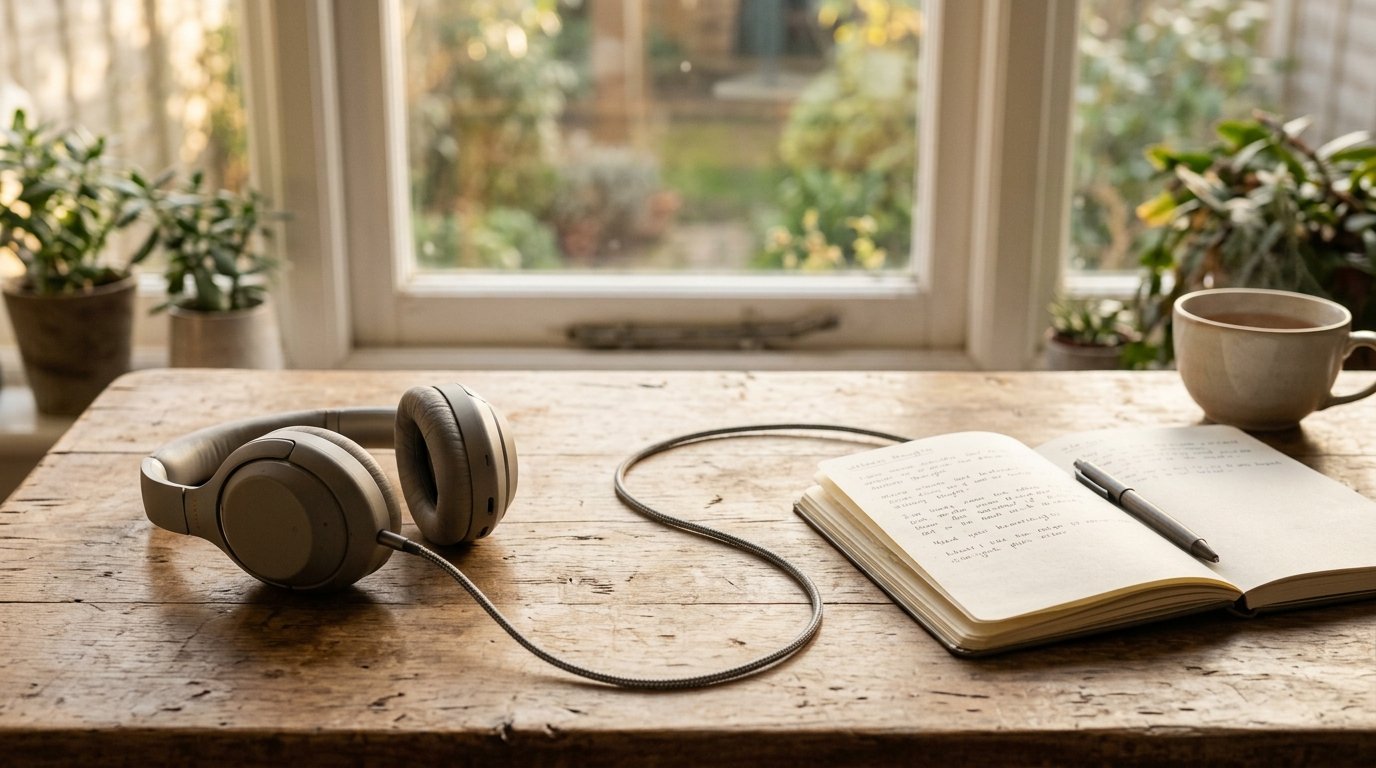
Music Lowers Your Stress. Here’s How to Use It Tonight.
Your nervous system does not need a spa day, an hour of meditation, or a perfect routine to come down. A meta-analysis of 47 studies found that music therapy has a medium-to-strong effect on stress-related outcomes (effect size _d_ = 0.723), reducing both cortisol and heart rate in participants across medical and mental-health settings. That means a song you actually like can do in minutes what an expensive schedule hopes to do in weeks.
The catch is in how you use it. Research is clear that tempo, personal choice, and intention all change the result. Below is the science in plain terms, plus a one-song routine you can run tonight.
What the science actually says
The strongest recent summary is a 2025 scoping review in JMIR Mental Health that drew on 34 studies measuring stress through biomarkers like cortisol, heart rate variability (HRV), and blood pressure. Its conclusion: music, especially classical pieces and songs a person chose themselves, reliably reduces physiological stress markers in adults.
A larger 2022 meta-analysis in Health Psychology Review (47 studies, 76 effect sizes, nearly 2,747 people) found music listening and music therapy both reduce stress-related outcomes, with a combined medium-to-strong effect size (d = 0.723). Tempo mattered: music at 60–90 beats per minute produced the largest effects (d = 0.900).
This is why your favourite slow song can feel like a reset: your heart, breathing, and nervous system track the beat.
How it works
Music reduces stress through several channels at once, which is why it works for so many people:
- Bottom-up calm. Slow tempo music (under ~90 bpm) synchronizes your heart rate with the rhythm and promotes vagal activation, the part of your nervous system responsible for the rest-and-digest state.
- Cortisol reduction. Multiple studies show listening to music, especially preferred or classical music, lowers salivary cortisol, the body’s primary stress hormone.
- Distraction you want. Music narrows your attention onto the sound, giving a rumination-and-worry loop less bandwidth. It is an intentional reset rather than a blank stare at a ceiling.
A 4-step music reset you can use tonight
This is not a meditation and it does not take discipline. It takes one song and roughly four minutes.
- Pick a song you actually love with a slower tempo (roughly 60–80 bpm). Your own taste does the heavy lifting here, so it does not have to be “calm” in any broad sense, only calming to you. Investor news articles about the perfect playlist miss the point.
- Put on headphones. Blocking ambient noise matters as much as the music itself, because sound you do not have to fight is weaker.
- Breathe in for 4, out for 6 for the length of one chorus. The longer exhale engages the vagus nerve directly, and the music carries you.
- Do not switch songs. Give the track the full play. Replaying a single familiar song after a stressful moment is a habit backed by the same studies.
That is the whole practice. It does not require an app, a subscription, or a teacher.
How to choose music that calms (and music that does not)
| Music trait | Effect on stress | Why |
|---|---|---|
| Slow tempo (60–90 bpm) | Reduces cortisol & heart rate | Heart rate and nervous system follow the beat |
| Music you choose yourself | Largest calming effect | Personal resonance activates reward and memory |
| Classical / ambient / instrumental | Reliable reduction | Less lyrical processing, fewer abrupt changes |
| Fast, loud, surprising (for during a crisis) | Can add arousal | Useful for energy, not for winding down |
| Songs tied to painful memories | Can be triggering | Context of memory matters |
Real talk: the research also flags a fail case. 15–20% of people in one review had a negative reaction to music (music-evoked chills or discomfort). If a song makes you feel worse, switch it. There is no single antidepressant soundtrack.
What to do when you are genuinely too flooded to pick
Sometimes you are too spun up to even choose a song. That’s when routines matter. Any slow/ambient track at roughly 60–90 bpm, loud enough to fill a room, works. Make a fallback or pre-saved slow playlist once, on a good day, so you never have to think about it later. State the song names now, not when you are triggered.
Also, music is a stress sharp tool, not a replacement for professional care. If you are carrying depression, panic attacks, or a mental health diagnosis, use music as one layer alongside a clinician’s care.
How this fits into your BetterLife practice
This dovetails with our other evidence-backed resets. If you want the full nervous-system breakdown, our mental stress relief shortcuts post covers PMR, HRV, breathwork, and cold water together. Music is the one that fits in your pocket and takes the least setup, so keep it as the on-ramp.
FAQ
Can one song really reduce stress?
Yes, the evidence does not require a long session. A single slow, personal track measurably lowers reported stress and cortisol, though more regular use produces bigger gains (multiple sessions had larger effects in the meta-analysis).
What tempo of music is best for calm?
Roughly 60–90 beats per minute. Research found this range produced the strongest stress reduction effect (d = 0.900) versus music with no specific tempo.
Does classical music work better than other types?
There is no magic genre. The key variables are slower tempo and your own preference. A pop song you love at ~70 bpm can be more calming than a classical piece you do not connect with.
Is music as effective as meditation for stress?
A 2022 comparison found music therapy produced even greater reductions in subjective distress than mindfulness training, though both reduced cortisol and heart rate. They complement each other; music needs no prep.
Could music ever make stress worse?
Yes, for a minority of people. If you feel worse, stop. The studies flagged that sound can both alleviate and induce stress depending on the person and context.
—
Sources
- De Witte et al. (2022). Music therapy for stress reduction: a systematic review and meta-analysis. *Health Psychology Review*. doi:10.1080/17437199.2020.1846580
- Saskovets, Saponkova, & Liang (2025). Effects of Sound Interventions on the Mental Stress Response in Adults: Scoping Review. *JMIR Mental Health*.